The linearinterpolationformula is the simplest method that is used for estimating the value of a function between any two known values. Understand more on linearinterpolationformula along with derivation, examples, and FAQs.
Linearinterpolation on a set of data points (x0, y0), (x1, y1), ..., (xn, yn) is defined as piecewise linear, resulting from the concatenation of linear segment interpolants between each pair of data points.
What is the LinearInterpolationFormula? The formula of linearinterpolation is given by Linear Interpolation (y) = y1 + [ (x-x1) × (y2-y1)]/ (x2-x1) Where, (x1,y1) & (x2,y2) are coordinates. x is the point to perform interpolation. y is the interpolated value. Applications of Linear Interpolation Formula Data Prediction. Data Forecasting.
Learn the definition, explore the formula, and delve into real-life examples that illustrate the application of linearinterpolation in mathematical analysis. Enhance your understanding of this valuable technique through this comprehensive resource from Mathful.
In this article, you’ll learn what linearinterpolation is, how to calculate it, and when to use it—with an easy-to-follow example. What Is LinearInterpolation? Linearinterpolation is a method of estimating an unknown value that lies between two known values.
This article will provide you with the linearinterpolationequation and explain in detail how to use it. Thanks to this calculator, you will be able to find the linearinterpolation (or extrapolation) in no time!
To find the value of y, for a given, x1, y1, x2, y2 and x, we need to apply the linearinterpolation (extrapolation) method. Step 1. Calculate the slope m of the line, with the equation: Step 2. Calculate the value of y using the line equation: For a better understanding, let’s look at some practical examples.
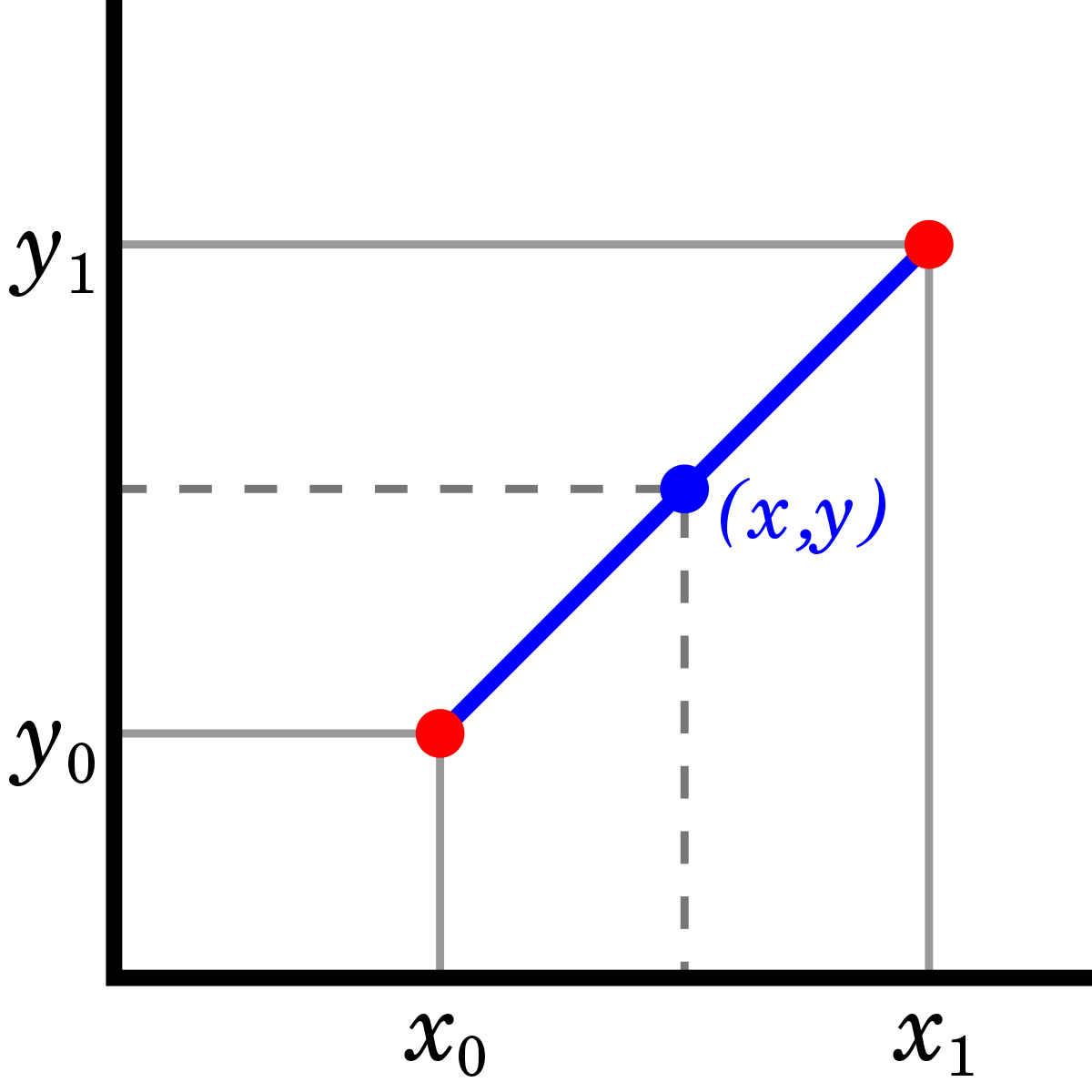 Linear interpolation on a set of data points (x0, y0), (x1, y1), ..., (xn, yn) is defined as piecewise linear, resulting from the concatenation of linear segment interpolants between each pair of data points.